


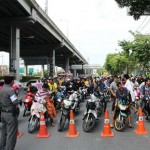
The sight of a 100 strong group of motorcyclists blocking a Bangkok road this week in a protest against police raises many questions.
The motorcyclists on this occasion were representing an online “liberation” group that wants to see not just changes in the law or its enforcement, but an end to police who routinely extract “fines” from them.
The demonstration that blocked Rama IV Road on Sunday is the latest reaction to online video posts in the war sometimes described as “Bikers vs Plod”.
Since time immemorial motorcyclists in Thailand have been fined, sometimes legally sometimes not, by police who claim, among other things, they are riding in the right lane of major roads. Most riders prefer to do this to avoid the dangers of collisions in the left lanes that are much too dangerous for them.
While many feel that the law is idiotic and is really just another excuse for “contributions to the policemen’s ball”.
Many who have lived and ridden in the capital for years know that checkpoints serve very little purpose other than to act as money making exercises for cops. While some checkpoints may be legal many are not as activist Kriengkrai Thai-orn has claimed with his campaign against those members of the constabulary who set up on provincial highways.
In Bangkok most motorcyclists know where and when police are likely to be in evidence – these are mostly after forbidden overpasses and tunnels and in areas where bikes like to travel on the right to avoid things like almost certain death!
Sundays are very popular for “Dan Tamruat” (police checkpoints) as are times between the rush hours when cops have downtime from other more pressing traffic duties. Mostly in rush hours bikers can do as they please with no fear of being stopped as police are otherwise detained.
The practice of fleecing motorcyclists has been going on decades since bikes started to become popular in the 1960s. The riders were always seen as unlikely to be people of influence and thus easy prey. They could also be easily seen not being behind tinted windows.
While car drivers also pay needless fines they are very infrequently stopped compared to the open season on bikers.
For me – having ridden a third of a million kilometers on bikes on the capital’s roads over the last near three decades– it has been a game to try and avoid them as well as a right pain in the derriere when unable to escape their long arm clutches.
And often for doing nothing more wrong than trying to extend my life where possible.
The time is well overdue for police to do something more useful and for more areas of the capital’s roads to be allowed to be used by motorcyclists. We are after all not responsible for most of the snarl ups that plague the capital. Cars do the best job of that.
And by the same token of public spiritedness, motorcyclists need to refrain from seeing it as a god given right to use the footpath, break through red lights when it pleases them and disobey other more serious road laws that can cause accidents and trouble for car drivers and pedestrians.
It is after all a two way street and respect has to be shown both ways.
After buying my first motorcycle – an MTX – in 1989 I was ill-prepared for “Biker vs Plod” but the interactions by the side of the road especially over the subsequent ten years provided not just invaluable experience but enough amusing anecdotes to fill a book.
There was the time when I was let go for showing a picture in my wallet of the Thai wife and kids instead of my license. The occasion at an intersection when a policeman asked me to place my “fine” behind a poster pinned up in the booth – I went inside to secrete my 100 baht behind a picture of a bare breasted Mekhong girl attached to the wall. All so no one would see.
Frequently good Thai language skills – and a willingness to politely state my side of things – saved many fines. Distracting officers by talking about David Beckham or the number of chilies one could eat in Som Tam were also good ploys.
As a foreigner I felt I had an advantage over the poor Thai men who just had to cough up, though maybe they negotiated a better “settlement” than me.
In the 1990 it was becoming increasing evident that police were issuing far more fines on paper tickets. In fact I would say that on many occasions in the last twenty years or so licenses are taken and fines have to be paid at police stations.
But does that mean an end to corruption? Not necessarily. I remember one occasion years ago when I showed up to pay a ticketed fine and get my license back at the very same booth where Sunday’s demonstration occurred only for an alternative payment method and figure to be suggested by the officer on duty.
However, my favorite story was my brother who after being fined for nothing by a roadside officer, took out a pen and pointedly wrote down the cop’s name on a sheet of paper before smiling and driving off. The officer literally chased him to the next intersection to salute him, apologize for the ‘error’ and give him his money back.
Of course, this was all in the days before mobile phones and video evidence that is rapidly changing the way the public can scrutinize and share the actions of the police with a wider audience.
And one senses that there are likely to be changes in the air as the cops increasing come under the spotlight not just from the public but from their superior officers worried about the image of the force that can no longer deny the virtually institutionalized wrong doing of some of its personnel.
Motorcyclists – part of the great down-trodden in many ways – are now as empowered as the next man or woman due to the technology and are becoming increasing emboldened to use it to further their cause and claims for justice.
It was no surprise to see the top brass turn out on Sunday to hear the complaints of the rider who claims he was spoken to rudely as a fine was issued for driving on the right side of the main road. He said the cop concerned would not listen to his explanation – then drove off over his foot in the wrong direction of traffic flow!
Naturally, most of this was caught on tape and shared online and when the metropolitan region two commander conceded certain things to the crowd they happily cheered and dispersed.
We shall see if anything concrete comes of it though many bikers will still inevitably be resigned to the status quo.
It will probably take the almost mythical concept of police reform to happen before anything will really change.
Gerry Carter





Popular posts – last 7 days
 Thailand Amazing Durian & Fruit Fest 2017 at… May 18, 2017 Experience Thailand’s largest durian and Thai fruit festival and enjoy… (173)
 Why does Thailand have so many traffic deaths? June 20, 2017 According to an article in Forbes Magazine in 2016, Thailand… (46)
 Snakes alive – beware the month of June in Thailand June 14, 2017 Those you follow the Thai news may remember the flurry… (40)
 5th Session of Lusophone Film Fest at Alliance française de June 14, 2017 It's time for your favorite films around the world! The… (31)
 New Tony’s Fitness at The Palladium Pratunam Bangkok February 3, 2014 Tony's Fitness latest center @ The Palladium Pratunam now open,… (27)
 French Cheese Night in The Backyard At 99 Rest Backyard Cafe June 20, 2017 Enjoy your evening with wine and cheese! Join us for… (25)
 La Fête de La Musique 2017 at Sofitel – 22 June 2017 June 15, 2017 Don’t miss an unforgettable evening of music and cocktails! A… (18)
 Canada Day 150 Festival at The British Club Silom Bangkok 17 June 8, 2017 This is an event you won’t want to miss! Please… (16)
 Thailand Brew Fest 2017 at Quaint Bangkok 7 July 2017 June 9, 2017 It's time for the first Thailand Brew Fest! More than… (16)
 SHINEE CONCERT SHINEE WORLD V in BANGKOK at Thunder Dome 24… June 6, 2017 Shinee is back in Bangkok! There isn’t much music out… (15)